GEO Strategy
Generative Engine Optimization (GEO): How to Win Visibility in AI Search
Learn how to build AI search visibility with a practical GEO strategy covering technical access, content, entity authority, citations, and measurement.
Generative Engine Optimization (GEO) is the practice of structuring your content, technical foundation, and off-site authority so that AI-powered platforms (ChatGPT, Google AI Overviews, Perplexity, Gemini, and Claude) select and cite your brand when generating answers for users.
This is a different objective than traditional SEO. The goal is no longer just a ranked link on a results page. It is inclusion inside the synthesized answer itself. That is where most users now stop reading.
The shift is already happening. Google AI Overviews now appear on a significant share of commercial queries, and platforms like Perplexity and ChatGPT have collectively reached hundreds of millions of monthly active users. Brands not optimizing for AI citation are already behind. Competitors who started earlier are earning those citations instead.
Key Takeaways
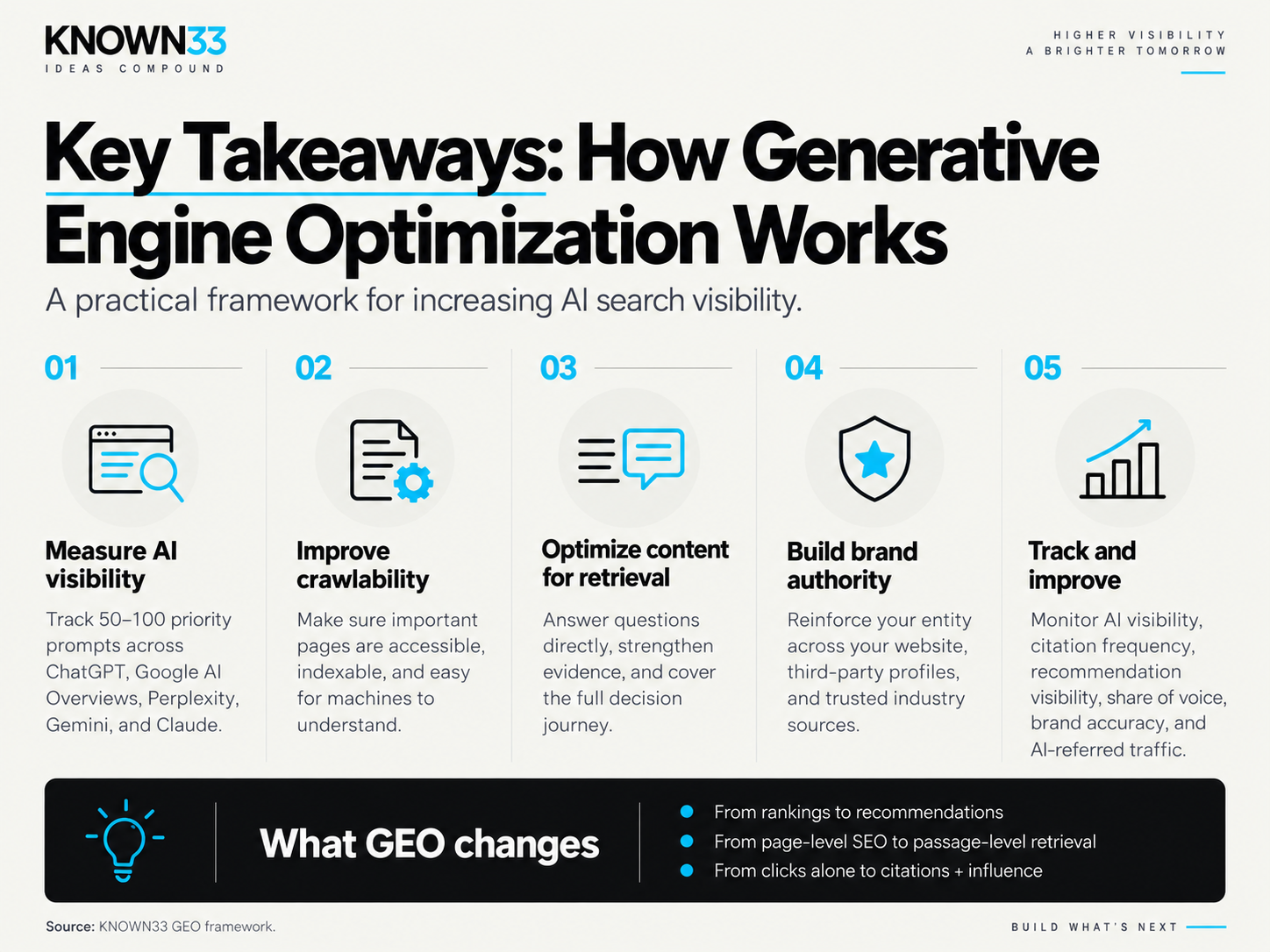
GEO makes your brand easier for AI systems to crawl, understand, and cite. The fastest path: audit where you appear today, fix crawlability and schema, rewrite core pages so each section answers a specific question, then build entity authority and track citations. Each stage compounds on the one before it.
Key takeaway: GEO is not a replacement for SEO. It is an extension of it, applied to a new retrieval layer. Brands that treat it as a separate discipline from day one will build a durable advantage.
Step 1: Run a GEO Audit to Establish Your Baseline
Before you optimize anything, you need to know where you currently stand inside AI-generated answers. Most brands have no idea whether they are being cited, misrepresented, or ignored entirely. That blind spot is the first thing to fix.
What a GEO Audit Covers
A thorough audit answers four questions:
Are major AI engines citing your content at all? Run 50 to 200 prompts relevant to your category across ChatGPT, Perplexity, and Google AI Overviews. Include branded queries ("What is [your company]?"), category queries ("What is the best [product/service] for [use case]?"), and competitor queries to see where rivals are appearing instead of you.
Can AI crawlers actually read your site? Check your
robots.txtfile for blocked user agents. The ones that matter most:GPTBot(OpenAI),PerplexityBot,ClaudeBot, andGoogle-Extended. If any of these are disallowed, those platforms cannot index your content. You are invisible to them entirely.Is your brand represented accurately? AI engines sometimes hallucinate or pull outdated information. Audit the descriptions, claims, and facts being attributed to your brand in generated answers.
Where are competitors earning citations you are missing? For every prompt where a competitor appears and you do not, you have a specific content or authority gap to close.
Prompt Testing Methodology
Structure your prompt set across three intent categories:
Intent Type | Example Prompt | What You Learn |
|---|---|---|
Branded | "What does [Brand] do?" | Accuracy of brand representation |
Category | "Best [solution] for [use case]" | Citation share vs. competitors |
Problem | "How do I solve [pain point]?" | Content coverage gaps |
Run this audit quarterly. AI engine behavior changes as models are updated. New content also enters their training and retrieval pipelines.
Step 2: Fix Your Technical Foundation for AI Crawlability
Content structure and authority mean nothing if AI crawlers cannot access your site in the first place. Technical GEO is the unglamorous prerequisite that most brands skip, then wonder why their content is not being cited.
Open the Door to AI Crawlers
Start with robots.txt. Confirm that GPTBot, PerplexityBot, ClaudeBot, and Google-Extended are explicitly allowed. If you inherited a site with a blanket Disallow: / rule, you may be blocking every AI crawler simultaneously.
Beyond permissions, check your server logs for these user agents to confirm they are actually crawling. Permission and activity are two different things.
Critical technical note: Many AI crawlers do not execute JavaScript. If your site relies on client-side rendering, important content like product descriptions, pricing pages, and case studies may be invisible to LLMs. Server-side rendering is the safer default for content you want AI engines to retrieve.
Implement an llms.txt File
An llms.txt file, placed at the root of your domain, gives AI systems explicit guidance on how to interpret your site. Think of it as a robots.txt for LLMs: you can specify which pages are most authoritative, which should be prioritized for citation, and how your brand should be described. While not universally supported yet, adoption is accelerating as AI platforms standardize their crawl protocols.
Structured Data: The Highest-Impact Technical Action
Research cited in Search Engine Land identifies structured data implementation as the single most impactful technical GEO action. LLMs rely on schema markup even more heavily than traditional search crawlers, because it provides unambiguous semantic context.
Implement the following schema types as a baseline:
Organization (sitewide, on homepage or About page): your brand name, description, logo, and social profiles
WebPage (every page): canonical context for each URL
Article (all editorial content): author, publish date, and topic
FAQPage (Q&A content): structured question-answer pairs that AI engines extract directly
HowTo (instructional content): numbered steps that map to AI-generated how-to responses
BreadcrumbList: hierarchical context that helps LLMs understand your site structure
Validate all schema output using Google's Rich Results Test before and after implementation.
Step 3: Optimize Content for AI Retrieval and Citation
Once AI crawlers can access your site, the next question is whether your content is structured in a way that makes it easy to extract and cite. LLMs do not read the way humans do. They retrieve passages, not pages. Every section of your content needs to stand on its own as a quotable, self-contained answer.
Write With BLUF Structure (Bottom Line Up Front)
The most important structural change you can make is to lead every major section with the direct answer, then expand with context and evidence. This is called BLUF (Bottom Line Up Front), and it mirrors how AI engines construct their responses.
What most content does: Paragraph of context → paragraph of background → paragraph of caveats → answer buried at the end.
What GEO-optimized content does: Direct answer in sentence one → supporting evidence → context and nuance → examples.
Apply this to every H2 section. The first sentence of each section should be extractable as a standalone citation. If it requires the surrounding paragraphs to make sense, it will not be cited.
Evidence Density: The Citation Multiplier
A 2024 study published on arXiv found that targeted GEO techniques can increase visibility in generative responses by up to 40%. The top-performing techniques: adding citations, statistics, quotations, and authoritative language. Vague claims get ignored. Specific, sourced data gets cited.
Apply this standard to every major claim in your content:
Replace "many companies" with a specific number and source
Replace "significant improvement" with a percentage and timeframe
Replace "experts agree" with a named expert and a direct quote with attribution
Add a source link to every statistic, not just in a footnote but inline, in the sentence
Cover the Full Query Fan-Out
AI engines do not answer a single keyword. They answer a conversational query that fans out across multiple sub-questions. For any given topic, users (and AI engines) expect answers to at least seven question types:
Question Type | Example |
|---|---|
Definition | "What is [topic]?" |
Comparison | "How does [A] compare to [B]?" |
How-to | "How do I implement [topic]?" |
Use case | "When should I use [topic]?" |
Objection | "What are the downsides of [topic]?" |
Entity expansion | "What tools/companies are involved in [topic]?" |
Metric | "How do I measure success with [topic]?" |
If your content only addresses two or three of these, a competitor who covers all seven will be cited in your place. Audit your top pages against this framework and fill the gaps.
Optimize Your FAQ Sections
FAQ sections are disproportionately powerful for GEO. AI engines rely heavily on structured question-and-answer pairs when building responses, because the format already mirrors how they output information. Add a minimum of six questions to every core content page, structured as:
The question (written in natural conversational language, not keyword-stuffed)
The answer in the first sentence (50 to 150 words total)
One specific data point or example in the final sentence
Derive your FAQ questions from Google Search Console query data. Filter for queries with six or more words and question modifiers. These are the actual questions your audience is asking, and the same prompts AI users are submitting.
Keep Content Fresh
AI retrieval systems favor content with clear, accurate publication and update timestamps. Refresh cornerstone content at minimum quarterly: update statistics, add new examples, and revise any claims that have become outdated. Display the update date visibly on the page and update the dateModified field in your Article schema simultaneously.
Step 4: Build Entity Authority and Off-Site Presence
AI engines do not just retrieve content from your website. They synthesize information from across the web, weighting sources by how authoritative and consistent they appear. If your brand's information is scattered, contradictory, or absent from the platforms LLMs draw from, your citation probability drops. This holds true regardless of how well your own content is optimized.
Establish Your Entity Across Core Platforms
An "entity" in the context of GEO is the machine-readable identity of your brand: a consistent, verifiable set of facts that AI systems can confirm across multiple independent sources. Building entity authority means making your brand unambiguous. LLMs need to confirm who you are across multiple independent sources before they trust you enough to cite you.
Start with these platforms, in priority order:
Wikipedia (if your brand qualifies by notability standards): a Wikipedia presence dramatically increases citation probability across all major AI engines
Wikidata: the structured data layer that feeds many LLM knowledge graphs; even without a Wikipedia article, a Wikidata entry for your organization is valuable
LinkedIn company page: consistently cited by AI engines as a primary entity reference for businesses
Crunchbase: particularly important for B2B and technology brands
Google Business Profile: signals entity legitimacy to Google's AI systems
Your About page: publish a clear, factual description of your organization with founder information, founding date, location, and core offering
All of these should describe your brand in consistent language. Contradictions across sources create ambiguity that reduces citation confidence.
Digital PR for AI Citation Value
Off-site authority in GEO works similarly to link building in traditional SEO, but the target is different. Instead of chasing domain authority scores, you are chasing mentions on the domains that AI engines already trust and cite.
Search Engine Journal and similar industry publications are consistently cited by AI engines in marketing and technology queries. A single mention in a Forbes or Harvard Business Review article can meaningfully increase the probability that AI engines reference your brand in relevant responses.
Practical digital PR actions for GEO:
Respond to journalist requests via platforms like Qwoted or HARO. A quoted expert attribution in a major publication creates a citation chain that AI engines follow.
Publish original research. Data that other sites reference creates the citation chains LLMs are trained to trust. Even a 100-respondent survey with specific, surprising findings qualifies.
Build brand mention monitoring. Track unlinked brand mentions across the web and request link additions. Every linked mention strengthens the entity signal.
Target publications AI models draw from. In the marketing and technology space, these include TechCrunch, Search Engine Land, Ahrefs Blog, and HubSpot Blog.
Seed Content Across AI-Native Platforms
Reddit, LinkedIn, and YouTube are consistently cited by AI engines as supporting sources. Publishing substantive content on these platforms, not thin promotional posts but genuinely useful answers and analysis, increases the surface area where AI engines can find and cite your brand.
The key insight here: AI engines do not just index your website. They index the web. Every platform where you publish authoritative content is another potential citation source.
Step 5: Measure GEO Performance and Iterate
Traditional SEO metrics (rankings, organic traffic, CTR) do not capture GEO performance. A brand can be cited in thousands of AI-generated answers and see zero change in Google Search Console click data, because AI Overview users often get their answer without clicking through. You need a different measurement framework.
The Four GEO Metrics That Matter
Metric | What It Measures | How to Track |
|---|---|---|
AI Citation Frequency | How often your brand appears in AI-generated answers for target prompts | Prompt monitoring tools (Profound, Peec AI, Semrush AI toolkit) |
Share of Voice | Your citations as a percentage of total citations in your category | Weekly prompt sweeps across ChatGPT, Perplexity, AI Overviews |
Citation Sentiment | Whether AI engines describe your brand accurately and positively | Manual review of generated answers, flagging inaccuracies |
AI-Referred Traffic | Sessions and conversions attributed to AI engine referrals | GA4, filtering for |
The metric most teams miss: citation sentiment. An AI engine can cite your brand frequently but describe it inaccurately, associate it with the wrong use case, or position it unfavorably relative to competitors. Frequency without sentiment monitoring is an incomplete picture.
The GEO Iteration Cadence
GEO is not a one-time project. It is an ongoing program. Structure your iteration cadence around three loops:
Weekly: Monitor prompt share of voice. Flag any prompts where competitor citations increased or your citations dropped.
Monthly: Update content based on monitoring data. Prioritize prompts with commercial intent and low current citation share. Refresh any page where statistics are more than six months old.
Quarterly: Full entity audit. Re-check all structured data, update off-site profiles, run a new round of crawler access verification, and re-evaluate your target prompt list as your product and market evolve.
Prioritize by Commercial Intent
Not all prompts are equal. A citation in response to "What is [your category]?" reaches early-stage researchers. A citation in response to "Best [your solution] for [specific use case]" reaches buyers. Focus your optimization effort on the prompts closest to purchase intent first, then expand to informational queries as your citation share grows.
GEO vs. SEO: What Changes and What Stays the Same
A common question from marketing teams is whether GEO replaces their existing SEO investment. The short answer is no, but the emphasis shifts in important ways.
What Carries Over From SEO
Traditional SEO authority signals remain relevant. Brands that rank in the top 10 organic results for a query have a meaningfully higher probability of being cited in AI Overviews for that same query. Domain authority, backlink profiles, and Core Web Vitals performance all influence AI citation probability, because AI engines use search rankings as one proxy for credibility.
The following SEO fundamentals translate directly to GEO:
Topical authority: comprehensive coverage of a subject area signals expertise to both crawlers and LLMs
Backlink quality: inbound links from authoritative domains increase the trust signals LLMs use to evaluate citation worthiness
Technical health: HTTPS, mobile optimization, and fast load times remain baseline requirements
E-E-A-T signals: author credentials, clear expertise attribution, and verifiable experience all factor into AI citation decisions
What Changes
The optimization target shifts from ranking position to citation inclusion. A page ranked #4 that is cited in every AI Overview for its target query may deliver more brand impressions than a page ranked #1 that is never cited. Measuring the right thing matters.
Content structure also changes significantly. SEO-optimized content is often written to keep users on the page longer. GEO-optimized content is written to be extractable in short, self-contained passages. These goals are not always in conflict, but they require different editorial decisions.
The most important shift: in traditional SEO, the metric is click-through rate. In GEO, the metric is reference rate: how often your brand is named in an AI-generated answer, regardless of whether the user clicks through to your site.
This does not mean clicks stop mattering. It means citation is the new top-of-funnel, and click-through is the conversion event downstream of it.
Start Your GEO Program: A Prioritized Action List
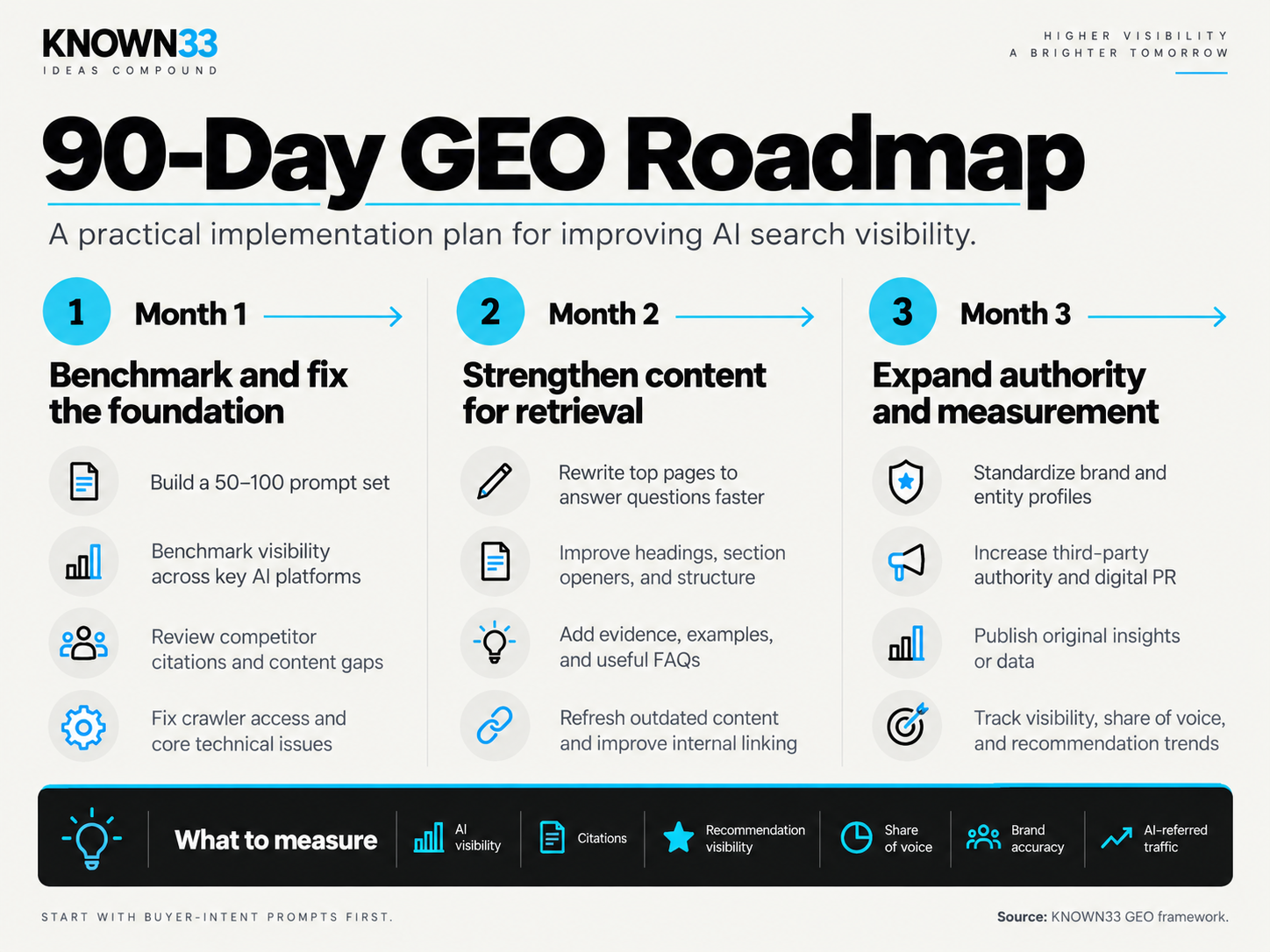
If you are starting from zero, the full GEO playbook can feel overwhelming. Here is how to sequence your first 90 days.
Month 1: Audit and Technical Foundation
Run 50 to 100 prompts across ChatGPT, Perplexity, and Google AI Overviews. Document where you appear, where competitors appear, and where no one appears (opportunity).
Audit
robots.txtand confirm AI crawlers are allowed.Check server-side rendering for all high-value pages.
Implement Organization and WebSite schema sitewide.
Add Article schema to all editorial content.
Month 2: Content Optimization
Rewrite introductions and section openers on your top 10 pages to use BLUF structure.
Add or expand FAQ sections on all core pages (minimum six questions per page).
Audit each page against the seven query fan-out categories; fill any gaps.
Add inline citations and source links to every statistic currently presented without attribution.
Month 3: Entity and Authority Building
Verify and update your LinkedIn company page, Crunchbase profile, and Google Business Profile.
Submit a Wikidata entry if one does not exist.
Identify three to five publications in your industry that AI engines cite frequently; pitch bylines or expert quotes to each.
Set up AI citation monitoring using a prompt-tracking tool and establish your baseline share of voice.
The compounding effect is real. Each stage of this program builds on the previous one. A brand with clean technical access, well-structured content, and consistent entity presence will outperform one with strong traditional SEO but no GEO investment. The gap will widen as AI search grows.
The brands that start now will be the ones AI engines have learned to trust by the time the rest of the market catches up.
MAKE YOUR NEXT MOVE AN INFORMED ONE