Brand Authority
How B2B Brands Build Authority That AI Engines Actually Cite: The KNOWN33 Methodology
Explore the KNOWN33 Authority Stack: a four-layer approach to entity foundations, authority content, digital PR, and AI visibility measurement for B2B brands.
Most B2B brands have been building authority the wrong way for years. Not because their content was bad, but because the definition of authority just changed underneath them.
For the past decade, brand authority meant ranking on page one of Google, earning backlinks from respected publications, and having your executives quoted in trade press. Those signals mattered because they influenced human readers who then made purchase decisions. The playbook was linear: create credible content, earn credibility signals, win buyers.
That playbook still works. But it now covers only half the game.
The other half: AI engines. ChatGPT, Gemini, Perplexity, and Google's AI Overviews now answer the questions your buyers used to type into a search bar. They don't return a list of links. They synthesize an answer and cite the sources they trust. If your brand isn't in that citation set, you don't exist in that moment of research, regardless of how much content you've published.
This is the core problem KNOWN33 was built to solve. The methodology described here, which the team calls the Authority Stack, is a structured approach to building B2B brand authority that works simultaneously for human buyers and AI discovery engines. It combines the disciplines that most agencies treat as separate: content strategy, technical SEO, entity optimization, and digital PR. The result is authority that compounds across every channel where your buyers research.
Key insight: According to research published on Search Engine Journal, AI answer engines draw heavily from a small pool of authoritative sources they've learned to trust. Getting into that pool requires a different set of signals than traditional SEO alone.
Why Traditional Authority-Building Falls Short in the AI Era
The conventional approach to B2B authority-building rests on three pillars: thought leadership content (articles, white papers, webinars), SEO (keyword targeting, backlink acquisition), and PR (media placements, analyst relationships). Executed well, this combination builds a brand that human buyers recognize and trust.
The problem is that AI engines don't evaluate brands the way human buyers do. They don't browse your blog, watch your webinars, or read your case studies linearly. They process structured signals about what your brand knows, what it's been cited for, and how consistently it appears as a trusted source across the web.
The Three Gaps Most B2B Brands Have Right Now
Gap 1: Entity ambiguity. AI systems need to understand who you are as a structured entity, not just what your website says about you. If your brand isn't clearly defined in knowledge graphs, structured data, and consistent entity signals across the web, AI engines can't confidently recommend you. Many B2B brands have strong content but zero entity infrastructure.
Gap 2: Citation-unfriendly content. Most B2B content is written to persuade, not to be extracted. AI engines favor content that makes definitive, factual, self-contained statements that can be quoted in isolation. Content built around narrative arcs, opinion, and brand storytelling is exactly what AI engines struggle to cite.
Gap 3: Single-channel authority signals. Traditional SEO builds authority primarily through backlinks. But AI engines triangulate authority across a much broader signal set: mentions in press, citations in academic and industry publications, consistent appearances across forums and communities, and structured data signals. A brand with 500 backlinks but no PR presence, no forum mentions, and no structured entity data looks authoritative to Google and invisible to an AI.
The real risk: Brands that don't address these gaps aren't just missing AI traffic. They're being actively excluded from the conversations their buyers are having with AI assistants, often at the exact moment those buyers are deciding which vendors to shortlist.
The Authority Stack: KNOWN33's Four-Layer Methodology
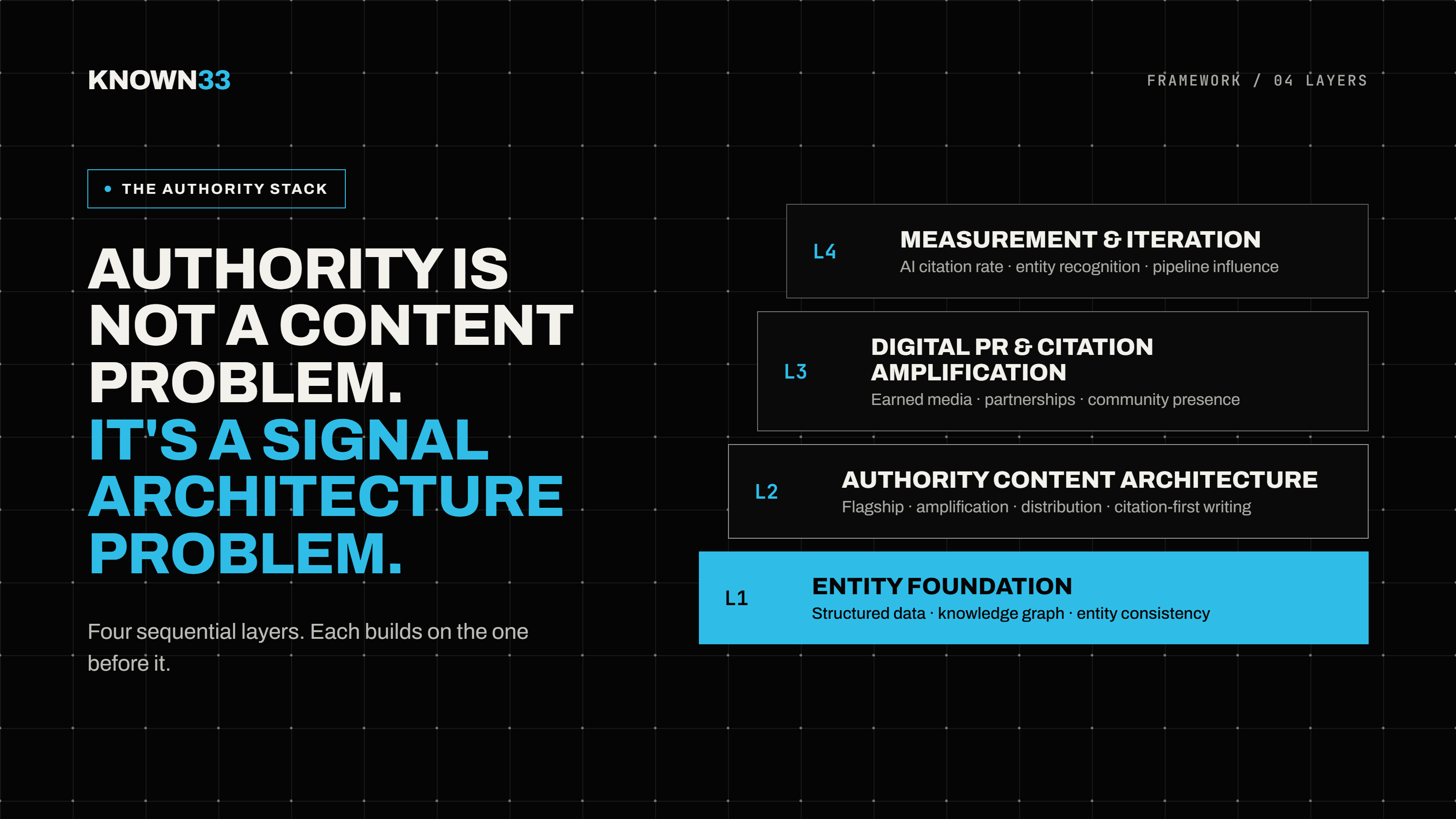
The Authority Stack is KNOWN33's proprietary framework for building B2B brand authority that performs across both traditional search and AI discovery. It operates in four sequential layers, each building on the one before it. Skipping a layer is possible; it just means the layers above it are unstable.
The framework was designed around a core insight: authority is not a content problem. It's a signal architecture problem. The brands that AI engines cite most consistently aren't necessarily the ones publishing the most content. They're the ones whose authority is legible to machines, not just to humans.
Layer 1: Entity Foundation
Before any content is created or any PR outreach is executed, KNOWN33 establishes the brand's entity infrastructure. This means ensuring that every machine-readable signal about the brand is consistent, complete, and crawlable.
The entity foundation work includes:
Structured data implementation: Schema markup (Organization, FAQPage, Article, BreadcrumbList) applied across the site so AI crawlers can extract and categorize brand information accurately
Knowledge panel optimization: Ensuring the brand has a verified, accurate presence in Google's Knowledge Graph, which serves as a primary reference point for AI systems when evaluating brand legitimacy
Entity consistency audit: Reviewing all third-party mentions, directory listings, and social profiles to ensure brand name, description, and category signals are consistent across the web
Topical authority mapping: Defining the specific topic clusters the brand wants to own, then mapping all existing content to those clusters to identify gaps and overlaps
This layer is largely invisible to human readers. It matters entirely to machines. Most agencies skip it because it doesn't produce a deliverable that looks impressive in a monthly report. KNOWN33 treats it as the non-negotiable foundation of everything that follows.
Layer 2: Authority Content Architecture
With entity infrastructure in place, the second layer builds the content that will generate citations. This is where most agencies start, which is why most authority-building programs underperform.
KNOWN33's content architecture for B2B authority is built around three content tiers:
Tier | Format | Primary Purpose | Cadence |
|---|---|---|---|
Flagship | Original research, benchmark reports, comprehensive guides | AI citation anchor, media coverage, backlink generation | Quarterly |
Amplification | Long-form articles, expert interviews, data-driven analysis | Topical authority reinforcement, organic search ranking | Monthly |
Distribution | LinkedIn posts, newsletter segments, short-form commentary | Audience reach, community presence, signal breadth | Weekly |
The critical design principle here is what KNOWN33 calls citation-first writing: every flagship and amplification piece is structured so that individual sections can be extracted and cited by an AI engine without requiring surrounding context. This means leading each section with a definitive answer, supporting it with specific data, and avoiding the kind of hedged, narrative-dependent writing that reads well to humans but is nearly unextractable by machines.
Flagship content deserves special emphasis. A well-executed benchmark report or original research study does something no opinion piece can: it creates data that other publications cite, which in turn creates citation signals that AI engines use to evaluate topical authority. HubSpot's research consistently shows that original data-driven content earns significantly more backlinks and media coverage than any other content format. The compounding effect of a single strong research asset can outperform 12 months of weekly blog posts.
Layer 3: Digital PR and Citation Amplification
Content without distribution is a signal that no one hears. The third layer of the Authority Stack is the systematic amplification of the brand's intellectual property through earned media, strategic partnerships, and community presence.
This layer is where KNOWN33's GEO expertise becomes most differentiated from traditional content strategy. The goal of digital PR in this framework isn't just coverage for coverage's sake. Every placement is evaluated against a specific question: does this create a citation signal that an AI engine will recognize?
The criteria for high-value placements:
Domain authority of the publication: Higher-authority domains carry more weight in AI training data
Topical relevance: A placement in a publication that covers the brand's exact topic cluster is worth more than a general business press mention
Linkback quality: Placements that include a contextual link back to the brand's flagship content create compounding citation chains
Structured entity mentions: Placements that reference the brand by its exact entity name (not a variation) reinforce entity consistency signals
Community presence, often overlooked in traditional PR strategies, carries growing weight with AI engines. Consistent, substantive participation in relevant forums, LinkedIn communities, and industry Slack groups creates a breadth of citation signals that press coverage alone can't replicate. Research from OpenAI and academic studies on large language model training data confirm that community-sourced content is heavily represented in the datasets AI systems learn from.
Layer 4: Authority Measurement and Iteration
The final layer closes the loop. Traditional content measurement tracks traffic, leads, and conversions. The Authority Stack adds a second measurement track specifically for AI visibility: which AI engines are citing the brand, in response to which queries, and with what frequency.
KNOWN33 tracks authority performance across four dimensions:
AI citation rate: How often the brand appears in AI-generated answers for target queries, measured across ChatGPT, Gemini, and Perplexity
Entity recognition score: Whether AI engines correctly identify and describe the brand when prompted directly
Topical citation breadth: How many distinct topic clusters the brand is being cited within, indicating the depth of authority recognized by AI systems
Pipeline influence: Whether content touchpoints are appearing in deals, shortlist decisions, and sales conversations, tracked through CRM attribution
This dual-track measurement model is what allows KNOWN33 to connect authority-building activity to revenue outcomes, not just visibility metrics. According to Search Engine Land, AI-driven search is fundamentally changing how marketing attribution works, and brands that don't build measurement systems for AI visibility now will be flying blind within 18 months.
What Makes This Different From a Content Marketing Retainer
The question KNOWN33 hears most often from prospective clients is a fair one: "How is this different from hiring a content agency?"
The honest answer is that it's a different category of engagement entirely. A content marketing retainer delivers content. The Authority Stack delivers a compounding infrastructure that makes every piece of content work harder than it would in isolation.
Here's the practical distinction:
Traditional Content Agency | KNOWN33 Authority Stack |
|---|---|
Produces content assets | Builds a citation infrastructure |
Optimizes for keyword rankings | Optimizes for AI citation AND keyword rankings |
Measures traffic and leads | Measures AI visibility, entity recognition, and pipeline influence |
Treats SEO and PR as separate channels | Integrates SEO, PR, and entity optimization into one signal system |
Starts with content creation | Starts with entity foundation |
Authority is a byproduct | Authority is the explicit product |
The compounding effect is the key differentiator. A blog post produced by a content agency has a half-life. It drives traffic for a period, then fades unless it's updated or promoted. A flagship research asset produced within the Authority Stack framework generates backlinks, earns press coverage, feeds the entity infrastructure, and becomes a citation source for AI engines, all simultaneously. Its value increases over time rather than decaying.
This is why KNOWN33 works on a performance-guaranteed model. The agency is confident enough in the methodology to tie its compensation to measurable authority outcomes, not just content deliverables. That's a structurally different incentive than a retainer that bills by the word.
The Timeline: What Authority-Building Actually Looks Like
One of the most common misconceptions about authority-building is that it's a long-term play with no near-term returns. That's not accurate when the methodology is structured correctly.
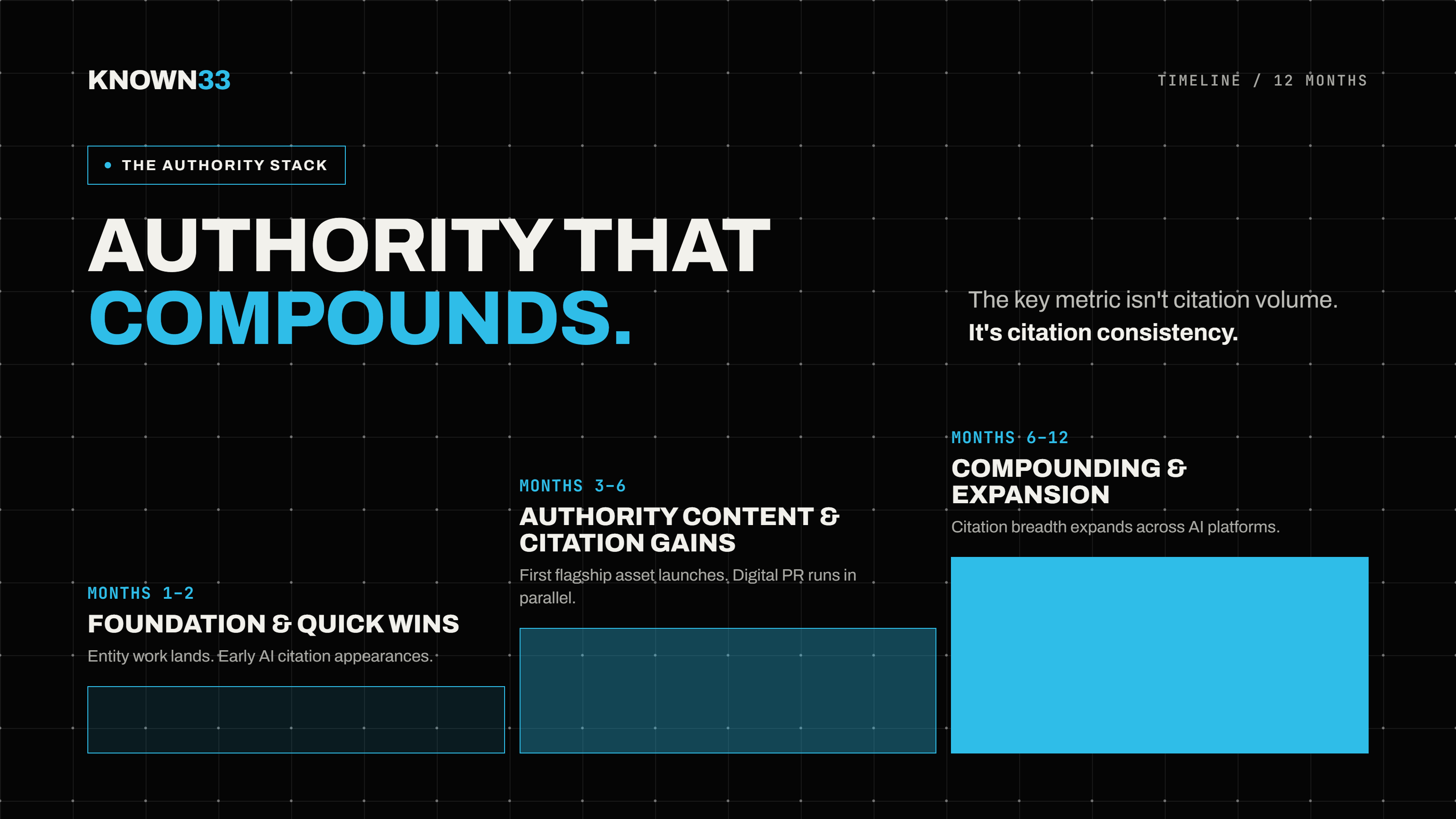
The Authority Stack operates on three time horizons simultaneously:
Months 1-2: Foundation and Quick Wins
The entity foundation work happens immediately and produces measurable results within weeks. Structured data implementation, entity consistency corrections, and knowledge panel optimization are technical interventions that AI engines pick up quickly. Brands often see improvements in entity recognition and early AI citation appearances before a single new piece of content is published.
During this phase, KNOWN33 also identifies the highest-leverage content gaps: queries where the brand's buyers are actively using AI assistants, where the brand is absent from AI-generated answers, and where a single well-structured piece of content could establish a citation foothold.
Months 3-6: Authority Content and Initial Citation Gains
The first flagship content asset launches in this window. This is typically a benchmark report or original research study targeting the brand's primary topic cluster. Simultaneously, amplification content (long-form articles, expert interviews) begins filling the topical authority map.
Digital PR outreach runs in parallel, targeting placements that generate citation-quality coverage. By the end of month six, most clients are seeing measurable AI citation appearances for target queries and meaningful improvements in organic search rankings for topically adjacent terms.
Months 6-12: Compounding and Expansion
This is where the Authority Stack's compounding nature becomes visible. The flagship content is generating inbound links and media references. Those references are reinforcing entity signals. AI engines are citing the brand with increasing frequency. The topical authority map is filling in, and AI citation breadth (the number of distinct queries the brand appears in) is expanding.
The key metric at this stage isn't citation volume. It's citation consistency. Appearing in AI answers for the same query repeatedly, across multiple AI platforms, is the signal that authority has been established rather than accidentally achieved. That consistency is what drives pipeline influence: buyers who encounter the brand through AI-generated answers multiple times during their research process arrive at sales conversations already pre-sold.
For B2B brands operating in competitive categories, this 12-month trajectory represents a durable competitive advantage. Authority built through the Authority Stack is significantly harder to replicate than a keyword ranking, because it requires consistent investment across content, PR, and entity infrastructure, not just a better-optimized page.
The Brands That Need This Most
The Authority Stack is designed for a specific type of B2B company: one that has real expertise, a credible product or service, and a buyer who does substantial research before making a decision. It is not a shortcut for brands with weak positioning or undifferentiated offerings. Authority-building amplifies what's genuinely there; it doesn't manufacture credibility from nothing.
The companies that see the fastest and most durable results from this methodology share a few characteristics:
Long sales cycles with multiple stakeholders: When buyers spend weeks or months evaluating vendors, they use AI assistants repeatedly throughout that process. Being cited consistently across that research journey has outsized impact on shortlist inclusion.
High-consideration purchases: The more a buyer needs to justify their decision internally, the more they rely on external authority signals. A brand that AI engines consistently cite as an expert source provides the kind of third-party validation that accelerates internal consensus.
Competitive categories with established players: When the market already has well-known names, newer or mid-market brands need a structural advantage to break into consideration sets. AI citation is one of the few channels where a challenger brand can achieve visibility parity with a category leader faster than traditional SEO allows.
Expertise-led businesses: Consulting firms, agencies, SaaS companies, and professional services providers have genuine intellectual capital to deploy. The Authority Stack is purpose-built to make that intellectual capital visible to AI engines, not just to human readers who happen to find the company blog.
If your buyers are asking AI assistants about your category, and they are, the question isn't whether to build AI authority. It's whether you're going to build it systematically or hope it happens by accident.
KNOWN33's authority content services are built around the Authority Stack methodology, with performance guarantees tied to measurable AI visibility outcomes. The first step is an authority audit: a structured assessment of where the brand currently stands across entity infrastructure, content architecture, citation signals, and AI visibility, and a prioritized roadmap for closing the gaps.
MAKE YOUR NEXT MOVE AN INFORMED ONE